
 EN
EN  ZH
ZH Fleet benchmarking is the best way to ensure your business remains competitive. In this article, we'll guide you through how fleet benchmarking truly measures performance, identifies actionable gaps, and...How Cartrack helps your business easily stay competitive..
Key points:
- Team benchmarking helps you measure your team's performance by comparing it to industry standards.
- It allows you to identify weaknesses in areas such as fuel usage, maintenance, and driving safety, so that you can make improvements.
- Avoid errors such as tracking incorrect data or failing to act on what has been learned.
- Cartrack Smart tools simplify benchmarking, enabling you to track, compare, and improve your fleet's performance.
What did successful teams do right in measuring performance?
Fleet benchmarking is to evaluate your fleetPerformance metrics compared with industry standards or similar teamsTo identify areas for improvement, they leverage insights to make informed business decisions.KPIAchieving success requires striking a balance between business objectives and clear understanding of how the business operates. This is how you move from guesswork to a clear understanding of how the business works.
Team benchmarking measures operational performance by examining metrics such as maintenance costs, fuel consumption, and driving behavior, and comparing them to best practices. Think of it as comparing your lap times to the top drivers on the track: only by knowing who's ahead and how big the gap is can you improve your speed.
There are two types of team benchmark assessments:
- Internal benchmarking assessment:Examine the performance of different parts of your operations (such as vehicle type or area) to identify best practices within your team.
- External benchmarking assessment:From a broader perspective, compare your performance to other teams or industry standards to understand where you stand.
Why should racing teams conduct performance benchmarking assessments?
Fleet benchmarking is essential to maintain competitiveness and consistently achieve peak performance. Fleet benchmarking is the simplest way to stay accountable, focused, and proactive in your business. Accountability stems from setting realistic and achievable goals, encouraging employees to review their performance and improve where possible. This transparency boosts morale and motivates you and your team to adopt more responsible and productive behaviors in your work.
Benchmarking also promotesData-based decision makingWhen you have the facts, you can confidently drive improvements (such as optimizing routes or scheduling preventative maintenance) and truly boost business productivity.
What does an effective fleet benchmark assessment measure?
Effective fleet benchmarking measures metrics that directly impact customer service, costs, and performance. Here are some key metrics:
- Fuel efficiency and cost per kilometer:Tracking fuel usage can help you identify bad routes or energy waste..
- Maintenance and downtime:Preventative maintenance means fewer unexpected failures and less costly downtime.
- Driving behavior and safety score:Focusing on safe and responsible driving means fewer accidents and better insurance rates.
- Vehicle utilization and route efficiency:Optimizing routes and using assets effectively means avoiding idling or wasting resources.
- Compliance and regulatory compliance:Complying with laws and regulations means you won't face hefty fines or damage to your business reputation.
Here is an example of a good and bad benchmark:
- Good benchmark:Driving safety scoreThe results consistently exceeded 90%, and the incidence of aggressive driving behavior was low, indicating stable risk management.
- Poor benchmark:A safety score below 75%, and frequent violent incidents,Lack of evidence of feedback or training.
Team Benchmark Evaluation Scorecard Example
Think of your team's benchmark assessment scorecard as a "report card". For example:
- Fuel economy:B–(R4.85/km vs R4.20/km (benchmark)
- Usage rate:C+(68% vs 80%)
- Driving safety:B(82% vs 90%)
- Downtime:C(14 vs 8 sky)
💡 Important NotesTreat industry benchmarks as a compass, not...GPSIt provides direction, but ultimately, you must plan the best route for your team. Just like in school, the goal isn't perfection, but progress.

What are the four stages of a team benchmark assessment?
Fleet baseline assessment consists of four phases: planning and defining objectives, data collection, action and execution, and review and monitoring. Fleet baseline assessment is most effective when the process has a robust structure. Each new change builds upon the previous one, thus creating value.值The data will translate into the next major business improvement.
Here are the four steps of this process:
- Planning and defining goals: Define the benchmark you want to perform.內The scope and reasons. Your goals should be realistic and beneficial to the business, so identify those that align with long-term growth.KPI.
- Data collection: Once you have set your goals, you will need to obtain them from reports or your...Fleet Management PlatformGather all the necessary information. Remember, the more accurate the data, the clearer the overall picture. From this, you can clearly see performance patterns and gaps.
- Take action and execute:Identify these gaps, and then develop an action plan. For example, if excessive fuel costs are the problem, then...Route optimizationDriving training might be the solution.
- Inspection and monitoring:Fleet benchmarking is an ongoing process. Review and monitoring allow your business to remain competitive in this ever-changing market. This practice enables businesses to...內Establish a culture of continuous improvement.
Common mistakes to avoid during benchmarking
Common mistakes to avoid when conducting benchmarking include: benchmarking without context, monitoring useless data, failing to take action, and ignoring ongoing updates. You may have invested a lot of effort in fleet benchmarking, but if your approach is incorrect, your efforts can be in vain.
Please remember these mistakes to avoid slowing down progress:
- Benchmarking in the absence of context:If you make incorrect comparisons between the fleets, such as with unrelated ones產If comparisons are made with industries or regions, the results may be inaccurate or confusing. Always conduct benchmarking within the correct context and ensure it is aligned with the correct industry or region.產Compare factors such as industry size and fleet size.
- Over-focusing on too many metrics or tracking unimportant data:Tracking too much information can drown out truly important data. Always stay focused.The metrics that are truly important for business growth orKPI.
- Failure to act based on insights:Gathering necessary information without taking any action will render all efforts futile. After collecting data, the next step should be to use this information to drive necessary changes and develop action plans to address business gaps.
- Ignore continuous data validation or updates:Over time, data accuracy becomes outdated. Outdated data, inconsistent reporting, and unverified sources can all lead to flawed business decisions. Please review your data regularly.查Your insights, and updated benchmarks to align with the team's current performance and trends.
How Cartrack Simplifies Fleet Benchmarking
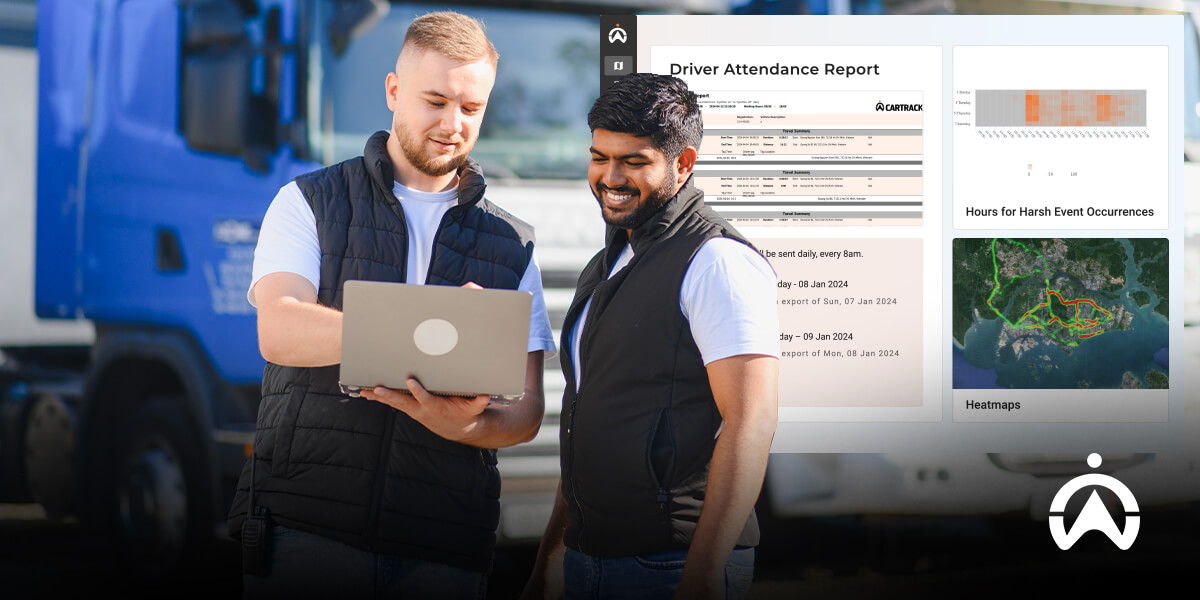
Cartrack By providing you with benchmark assessmentAll the necessary insights make fleet benchmarking simpler. As we understand it, the effectiveness of benchmarking depends on strong and accurate data insights behind it. Through CartrackYou will gain a smart and intuitive platform that enables you to夠We track, compare, and act with complete confidence. Here are our strengths:
- Data visibility:You can Cartrack 的 FleetWeb platformGain comprehensive access to all the information you need. From fuel consumption and driving habits to maintenance status, every aspect of your fleet is clearly visible. This makes it easier to spot those subtle business gaps.
- Customized reports andKPI:FleetWeb supplyAutomated ReportingIt also allows you to customize the process, simplifying the review process. You can gather any information you need without worrying about manual organization.
- Driving behavior analysis:We understand the importance of safety for the fleet.產The importance of force, therefore providingDriving monitoringWith the scorecard feature, you can provide guidance to drivers who need assistance, reward those who adopt safe driving habits, and create incentives for everyone.
- Simplified and automated information:Cartrack It eliminates the tedious data collection process. Through automation, you can quickly and confidently drive improvements without spending hours reviewing data.產The change required for force.
Final focus
Fleet benchmarking is crucial for a company's long-term success and continuous improvement.產The continuous evolution of the industry means that costs are constantly rising and customers...戶Demand is constantly increasing, and the need for comprehensive visibility is growing stronger. Fleet benchmark assessment allows you to...夠With all the necessary information, you no longer need to guess how your team is performing.Cartrack This can make the process simpler, turning accurate and automated data into a valuable business advantage.
Are you ready to benchmark in a smarter way and consistently outperform?Book a demonstration nowLet us show you the true performance of your fleet.
FAQ's
Q: How often should a team conduct a benchmark assessment?
A: The team should at least annuallyConduct a benchmarking review once a year, or quarterly if you prefer. This also depends on the pace of market growth. Regularly reviewing benchmarks ensures your data stays up-to-date and aligns business goals with plans for continuous improvement.
Q: Can small fleets also benefit from benchmarking?
A: Yes, small fleets can also benefit from benchmarking. Growth and development are not the exclusive domain of large corporations; small businesses can also fully leverage their resources. Through benchmarking, small operations can reduce costs, extend vehicle lifespan, and improve driving performance without requiring a large team or complex infrastructure.
Q: How do I know which fleet benchmark evaluation metrics are best suited for my business?
A: You can determine the most relevant benchmark metrics by identifying which indicators have the greatest impact on your profits. For example, driving habits and cost per kilometer (CPKThese are some key metrics. Ultimately, it still depends on the core objectives you define.
Q: How long will it take to see the results of the team benchmark assessment?
A: It typically takes several months before you start to see tangible results from team benchmarking assessments, but in some cases, it may take only a few weeks.內You'll see results soon enough. Indicators like driving instructions or fuel management usually reflect results quickly.